July 2026
Tax time 2026: prepare before you lodge, not after the ATO asks
The 2025–26 financial year has now ended. For many individuals, sole traders and small business owners, the first instinct after 1 July is to lodge quickly and wait for a refund. That can be tempting, but it is not always the best approach.
This year, a safer approach is to slow down, check the records, confirm that pre-filled information is complete, and make sure any deductions are supported before lodgement. The Australian Taxation Office has access to more data than many people realise. It can compare your tax return with information from employers, banks, share registries, crypto exchanges, digital platforms, property managers and other third-party sources.
Most tax issues do not arise because clients are trying to do the wrong thing. They often arise because income is forgotten, expenses are estimated, business and private costs are mixed, or records are not available when the ATO asks questions months later.
This newsletter outlines the areas the ATO is likely to question in 2026 and what you can do now, after 30 June, to prepare properly.
Why rushing after 1 July can create problems
Lodging early can be useful if your records are simple and complete. However, many tax returns are not complete in the first few days of July. Employers, banks, health funds, government agencies, share platforms and investment providers may still be finalising their reporting.
If you lodge before all information is available, you may miss income or claim deductions against incomplete data. That can lead to amendments, delays, ATO questions, interest charges or penalties.
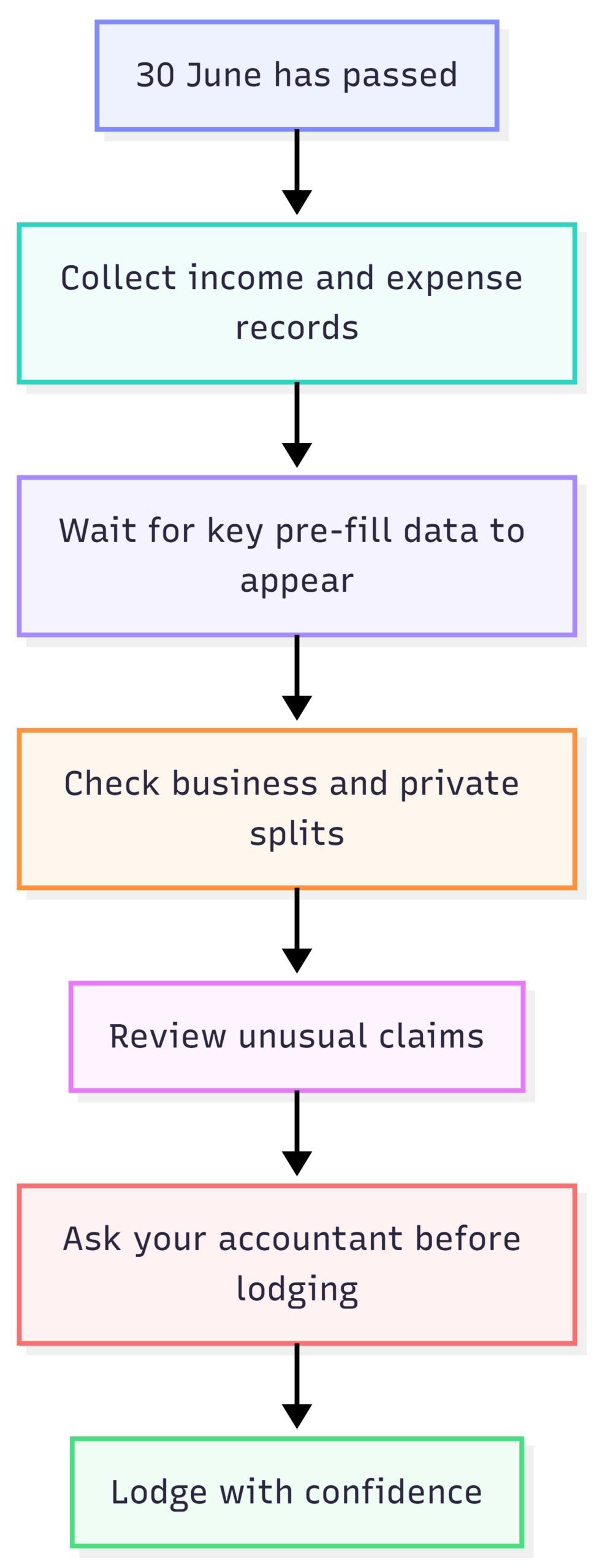
A better post-30 June approach
Work-from-home claims: evidence matters
Working from home remains one of the most common deduction areas. The ATO is likely to question claims that are rounded, unsupported or inconsistent with work patterns.
For 2025–26, many employees and home-based business operators may consider the fixed rate method or the actual cost method. The fixed rate method is simple, but it is not a “no records required” shortcut. You still need a record of the hours worked from home and evidence of relevant expenses.
Case study: Working-from-home claim
Maria is an employee who worked from home two days per week during the year. She worked 7.5 hours per day from home for 46 weeks.
Her total work-from-home hours are:
2 days × 7.5 hours × 46 weeks = 690 hours
If Maria uses a 70 cents per hour fixed rate method, her claim would be:
690 hours × $0.70 = $483
That may look modest compared with some large home-office claims. However, it is much easier to support if Maria has diary records, timesheets, rosters, employer emails, or calendar entries showing her work-from-home pattern.
If Maria also bought a $1,800 laptop used 80% for work, that may need to be considered separately under the depreciation rules. She should not simply deduct the full laptop cost without checking the correct treatment and business-use percentage.
Common ATO questions may include:
- Did you actually work from home on those days?
- Were the hours recorded or estimated later?
- Was the expense already reimbursed by your employer?
- Is there a private component?
- Have you claimed the same cost twice?
Rental property deductions: repairs, improvements and private use
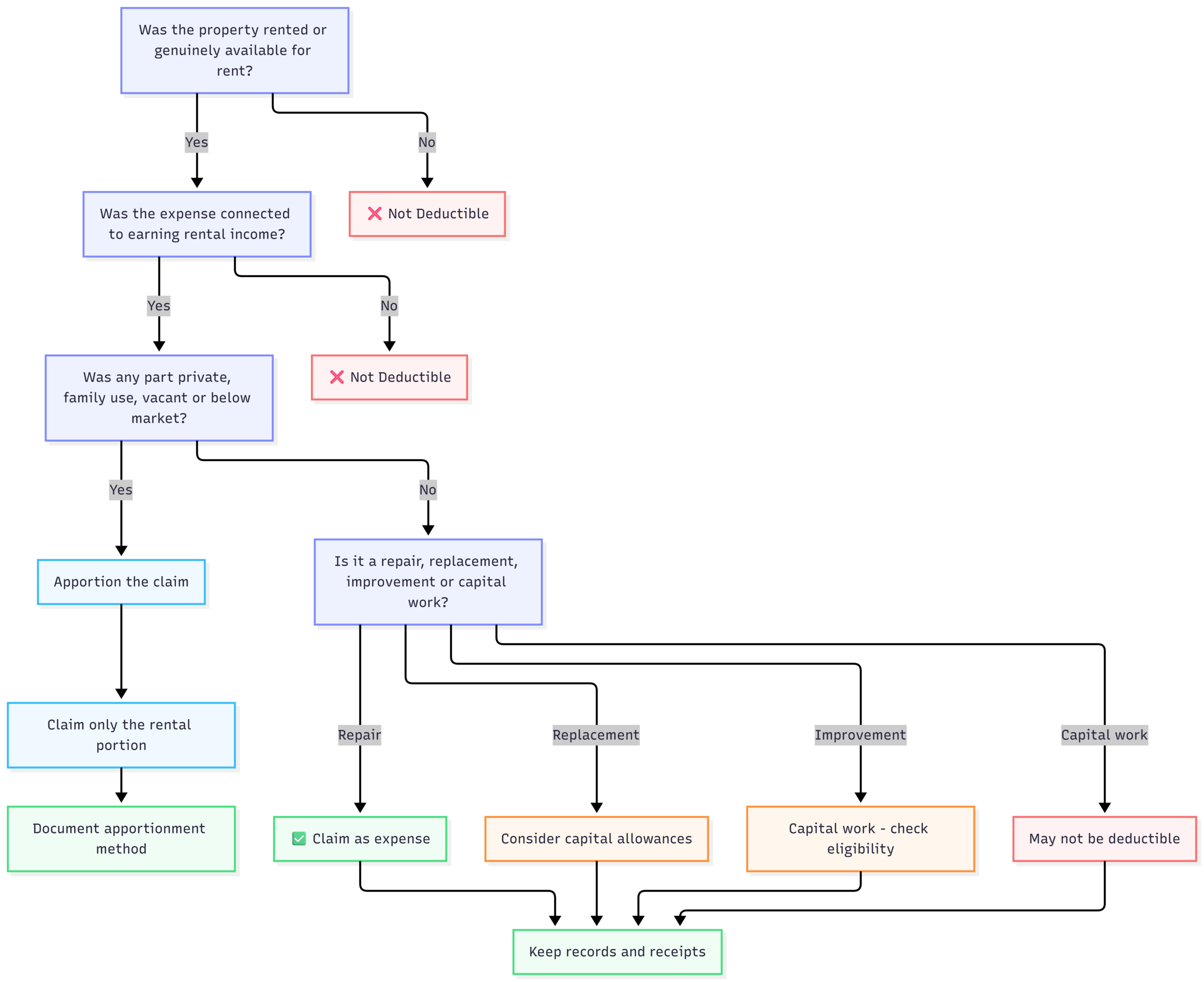
Rental property deductions remain a major area of review. The ATO is likely to question claims for interest, repairs, improvements, holiday homes, short-stay accommodation and periods where the property was not genuinely available for rent.
The key issue is whether the expense relates to earning rental income. If a property is partly used privately, rented below market rates to family, blocked out for personal use, or unavailable for rent, deductions may need to be reduced.
Case study: Repair or improvement?
Tom owns a rental property. During the year, he paid:
$3,600 to repair a leaking hot water system
$28,000 to renovate an old bathroom with new tiles, fittings and layout
The hot water repair may be deductible if it restores the existing item to working order and relates to the rental period.
The bathroom renovation is different. It improves the property and may be capital in nature. Instead of claiming $28,000 immediately, Tom may need to claim it over time under the capital works rules, if eligible.
The difference is important. If Tom claims the full $31,600 as repairs, the ATO may question the return. A more accurate approach is to separate repairs, maintenance, depreciating assets and capital works before lodgement.
Rental deduction flowchart
Side hustles and platform income: small amounts still count
Many clients now earn income outside their main job or business. This can include ride-share driving, food delivery, online marketplaces, Airtasker-style work, tutoring, content creation, short-stay accommodation, online sales, freelance services or weekend consulting.
A common mistake is assuming that a side hustle is too small to matter. If you are earning income from providing goods or services, it may need to be declared. If the activity has become a business, there may also be ABN, GST, record-keeping and superannuation issues to consider.
Case study: Weekend candle business
Amelia works full-time and sells handmade candles on weekends. During 2025–26, she received:
Online sales: $18,500
Market stall sales: $4,200
Total income: $22,700
Her costs included:
Materials: $7,200
Market stall fees: $1,100
Packaging: $900
Website and payment fees: $650
Total expenses: $9,850
Her net income before other adjustments is:
$22,700 − $9,850 = $12,850
Amelia cannot ignore this simply because it started as a hobby. She should discuss whether she is carrying on a business, whether she needs an ABN, how to treat stock, whether GST registration may become relevant in future, and what records she needs to keep.
If Amelia made a loss instead, she should not assume she can automatically offset that loss against her salary. Non-commercial loss rules may apply.
Crypto: every disposal can matter
Crypto is another area where the ATO receives data from third parties. Many investors understand that selling crypto for Australian dollars can trigger tax consequences. Fewer understand that swapping one crypto asset for another can also be a taxable event.
Common crypto records should include:
The date of each transaction
The type and quantity of crypto acquired or disposed of
The Australian dollar value at the time
Exchange fees
Wallet and exchange records
The purpose of the transaction
Case study: Crypto gain
Daniel bought Bitcoin for $5,000. Later, he sold it for $8,200. His exchange fees were $80.
His capital proceeds after selling costs may be:
$8,200 − $80 = $8,120
If his cost base was $5,000, his capital gain before any discount is:
$8,120 − $5,000 = $3,120
If Daniel held the asset for at least 12 months and satisfies the relevant conditions, he may be eligible for the CGT discount. If he held it for less than 12 months, the full gain may be taxable.
The ATO may question returns where crypto activity appears in exchange data, but no capital gain, capital loss or income is reported.
Shares, dividends and capital gains: do not rely only on pre-fill
Share investors often rely on pre-filled dividend information. Pre-fill is useful, but it may not capture everything needed for a correct tax return.
If you sold shares, units or exchange-traded funds during the year, you may need to calculate a capital gain or loss. This requires purchase records, sale records, brokerage, dates and any corporate actions.
Case study: Share sale
Priya bought shares for $12,000 and paid $40 brokerage fees. Her cost base is:
$12,000 + $40 = $12,040
She later sold the shares for $16,500 and paid $40 in brokerage fees. Her capital proceeds are:
$16,500 − $40 = $16,460
Her capital gain before any discount is:
$16,460 − $12,040 = $4,420
If Priya held the shares for more than 12 months, she may be eligible for the 50% CGT discount as an individual. The taxable capital gain after the discount may be:
$4,420 × 50% = $2,210
If Priya only checks her dividend pre-fill and forgets the share sale, the return may be incomplete.
Business and private expenses: the ATO will expect a split
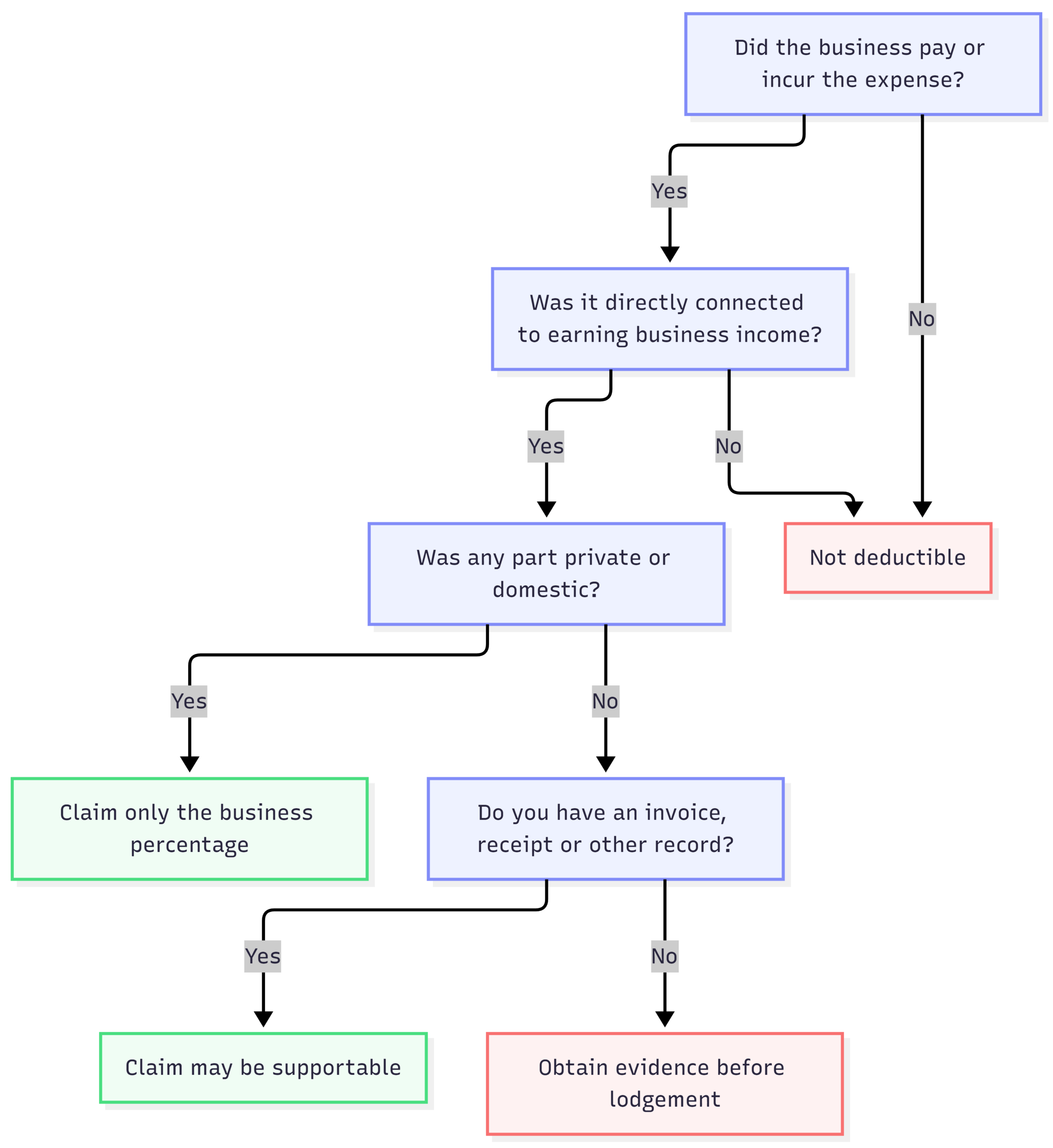
For small business owners and sole traders, one of the most important tax-time tasks is separating business expenses from private expenses. This applies to motor vehicles, phones, internet, home office costs, travel, meals, subscriptions, insurance, interest and equipment.
The basic principle is simple: if an expense is partly business and partly private, only the business portion should be claimed.
Case study: Motor vehicle costs
Sam runs a small electrical business. His vehicle expenses for the year are:
Fuel: $6,800
Registration and insurance: $2,900
Repairs and servicing: $2,400
Interest and other costs: $1,900
Total vehicle costs: $14,000
Sam’s logbook and records support 80% business use.
His deductible business portion is:
$14,000 × 80% = $11,200
The private portion is:
$14,000 × 20% = $2,800
Sam should not claim the full $14,000 simply because the vehicle is useful for work. The ATO may ask how the business percentage was calculated.
Business expense claim flowchart
Non-commercial losses: a loss is not always deductible against salary
Many sole traders and individuals in partnerships assume that a business loss can be offset against wages, investment income or other personal income. That is not always correct.
The non-commercial loss rules can apply when an individual’s business activity results in a loss. Depending on the facts, the loss may need to be deferred rather than claimed immediately against other income.
Case study: Consulting side business
Liam is employed full-time and has also started a weekend consulting activity. For 2025–26, he had:
Consulting income: $12,000
Consulting expenses: $20,000
Loss: $8,000
Liam wants to deduct the $8,000 loss from his salary. This may not be available automatically. He needs to check the non-commercial loss tests and whether the activity is genuinely commercial.
If the loss must be deferred, Liam may be able to use it against future income from that business activity, but not immediately against salary.
Small business concessions and CGT: eligibility must be proven
Small business CGT concessions can produce significant tax savings when selling a business, business premises or active business asset. However, the ATO is likely to question whether the eligibility requirements have been met.
This can include questions about:
- Whether the asset is active
- Who owns the asset
- The business turnover or net asset position
- Connected entities and affiliates
- The timing of the sale
- Whether the right concession has been applied
- Whether the structure matches the claim
Case study: Sale of a small business asset
Nina sells a business asset and makes a capital gain of $300,000. She assumes that because she runs a small business, she can reduce or disregard the gain.
That may be correct, but only if the conditions are met. If the asset was partly private, owned in a different entity, used by a related business, or not active for the required period, the result may change.
For larger transactions, it is risky to leave the analysis until after contracts are signed. CGT planning should ideally occur before sale negotiations are finalised.
Record keeping: the best defence is a complete file
The ATO can ask questions well after lodgement. A claim that seems reasonable today can become difficult to defend later if records are missing.
Useful records include:
- Receipts and invoices
- Bank and credit card statements
- Loan statements
- Rental property statements
- Share purchase and sale documents
- Crypto transaction reports
- Business accounting files
- Logbooks and diaries
- Work-from-home hour records
- Stocktake records
- Emails or documents showing a business purpose
For small business clients, a good post-30 June process is to reconcile bank accounts, review unpaid invoices, check debtors and creditors, finalise stock and work-in-progress records, review director loans, confirm payroll, and separate private costs before sending information to your accountant.
What you should do now
Now that 30 June has passed, the most useful action is not rushing. It is preparing a clean tax file.
Start by listing all sources of income. Include salary, business income, bank interest, dividends, rental income, trust distributions, capital gains, crypto activity, platform income and side-hustle income.
Then review expenses. Ask whether each claim has a clear connection to earning income, whether it includes any private component, and whether you have evidence.
Finally, identify anything unusual. Large repairs, business losses, new side hustles, asset sales, crypto trades, home-office claims and mixed-use expenses should be reviewed before lodgement.
Final message
Tax time 2026 is not just about completing last year’s return. It is also an opportunity to improve the way your records, structures and systems work for the year ahead.
A well-prepared return reduces ATO risk, avoids unnecessary amendments, and gives you better information for cash-flow planning, asset purchases, business growth and wealth decisions.
If you have rental property claims, side income, crypto, shares, a home-based business, mixed-use expenses, business losses or a potential CGT event, please contact us before lodging. A short review before lodgement can prevent a much larger problem later.
Please note: Our Newsletters are not the place for the giving or receiving of financial advice concerning investment decisions or tax or legal advice. This material has been prepared for informational purposes only, and is not intended to provide, and should not be relied on for, tax, legal or accounting advice. Any ideas and strategies should never be used without first assessing your own personal needs and financial situation, or without consulting or engaging with us as your professional advisors.